The New Digital Frontier: Let's Not Make the Same Mistakes Again
We're living through a new digital frontier, with AI transforming how we build, learn and create. But are we already repeating the mistakes of the page-builder era? As new tools and opportunities emerge, the choices we make now could shape our future independence.
I think we're living through something of a frontier era.
It's 2026, and we're stepping into territory that none of us fully understands yet. AI is changing how we build websites, develop software, learn new skills and create digital assets. The rules are still being written, and the opportunities are only just starting to reveal themselves.
It's a bit like the Wild West (and I'm wondering if it's an excuse to start rocking the stetson). We're all looking for our patch of land, deciding where to put down roots, building our foundations and choosing where to invest our time and effort.
And I think those choices are going to matter enormously.
What we learn today, the tools we adopt and the dependencies we create could determine just how much freedom and opportunity we have in the years ahead.
Haven't we been here before?
For years, WordPress page builders became the norm in web development, particularly in agencies.
And they had their place. They made website creation accessible to people who didn't know how to code, while giving experienced developers a faster, more visual workflow.
But somewhere along the way, we became dependent on them.
We learned the builders rather than the underlying technologies. We accepted proprietary systems, bloated output and workflows dictated by whichever platform we happened to be using.
The problem was that the convenience of pagebuilders came at a cost that web developers were not only aware of, but were fighting against. A range of Wordpress builders were doing their best to enable best web development practices to be achievable within the space, although it was still in the monster of Wordpress.
And now, just as AI has given us the ability to work directly with code more easily than ever before, I'm seeing a familiar pattern emerging.
New visual builders for Astro and static websites. WordPress builders experimenting with static output and cramming a convoluted AI workflow through their interfaces. More proprietary interfaces sitting between us and the actual files. This was commented on beautifully in Woji Piskorz's X article "There's no horse anymore"; and in that article he explained just what I was also thinking.
We're in danger of recreating the very thing we've just been given the opportunity to move beyond.
AI has changed the equation
AI can work directly with HTML, CSS, JavaScript and frameworks like Astro. It understands components, layouts, styling and project structures.
We can now create sophisticated websites and applications without manually writing every line of code.
That's an extraordinary opportunity, particularly for designers and people who previously found coding intimidating.
And I think it should encourage us to get closer to the code, rather than hide it away again.
I've been talking about a 10–80–10 approach to AI-assisted development.
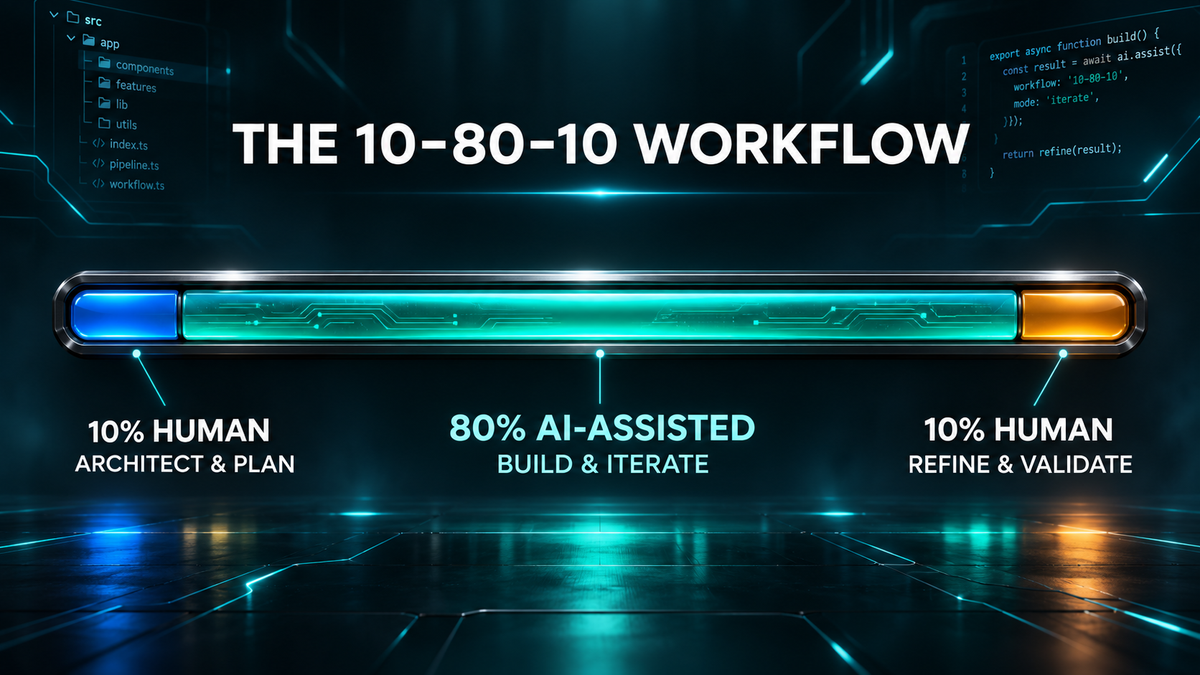
The first 10% is ours. Planning, architecture, design decisions and establishing what we're trying to achieve.
The middle 80% is where we work with AI to build, experiment and iterate, reviewing its work as we go.
The final 10% brings us back to the details. Refinement, accessibility, performance, testing and the little things that make a project genuinely good.
The percentages aren't particularly important. It's the principle.
We're directing the work, learning from the process and retaining control of what we create.
Tools should make us more capable
This is also the philosophy behind FEWD Studio.
I see FEWD Studio (Front End Web Development Studio) as a visual-first IDE, an integrated development environment. It brings together code editing, project navigation, visual styling, previews, terminal access and other development tools.
The visual features are there to help you work with your code. The actual project remains yours, using standard files and technologies.
You can open it in another editor, work with AI agents or abandon FEWD entirely and carry on developing.
That's important to me. I want people to use FEWD because they enjoy using it and find it productive, rather than because I've created a dependency they can't escape.
And to be clear, I'm not against visual development. Far from it. I love visual tools.
I simply think we should be careful about introducing unnecessary layers between ourselves and the things we're creating.
Choosing our place on the frontier
Coming back to that frontier analogy, we're all deciding where to build.
Some people will choose convenient, ready-made solutions. Others will explore the underlying technologies and develop skills they can take anywhere.
I think the greatest advantage we can give ourselves right now is adaptability.
The tools will change, so be careful about limiting yourself. AI models will improve, so don't limit them through a tool's MCP! New frameworks and workflows will emerge. Some of today's exciting products will probably disappear.
But an understanding of how things work, the confidence to experiment, and the ability to learn and adapt will remain incredibly valuable.
That's really what I want the Digital Builders Community to be about.
A place for designers, developers, freelancers and curious builders who want to explore this new territory together. We'll be learning modern web development, Astro, AI-assisted coding, SEO, digital asset creation and the practical skills that help us turn ideas into real projects.
We'll build things, share what works, challenge our assumptions and hopefully help each other stay close to the leading edge of what's possible.
Because I don't think the frontier advantage comes from knowing which tool to use today.
It comes from becoming the sort of person who can make the most of whatever comes tomorrow.
We're entering a new era. Let's build on foundations we understand, develop skills we actually own, and make the most of the opportunities ahead.
Join us at the Digital Builders Community.
And watch the accompanying video for more of my thoughts on AI, page builders and the new digital frontier.
Preferred sources
Follow my work in Google
Add chrisgood.online as a preferred source and my insights get pushed up your Google Search, News and Discover results.